
Your basket is empty
DTF vs DTG: A Guide to Choose the Right Print Method
If you’re looking to start in the apparel personalisation sector but not quite sure which print method is for you, you’ve come to the right place. We’ll take you through Direct-to-Film and Direct-to-Garment printing so you can choose which technology is right for you and your business.
DTF vs DTG: the short answer
If you want a quick and easy answer: DTF is usually better if you need versatility (as you can use it on cotton, polyester and blends) and want to print transfers in advance for batch pressing. DTG is usually better if you mainly print on cotton and want the softest feel for detailed, full-colour designs, especially for one-offs or print-on-demand.
Key takeaways
- DTF prints onto film, then heat-presses onto fabric, which is great for cotton, polyester and blends.
- DTG prints directly onto the garment, so it’s best for cotton/cotton-faced garments and a softer finish.
- DTF can be more efficient for batch workflows (print now, press later).
- DTG can be ideal for one-offs and detailed prints with minimal steps (but pretreat is key).
- The right choice depends on fabric type, order volume, and the feel you want on the garment.
If you’re still undecided, read on for a full breakdown, comparison and methods to match your business needs.
What is DTF Printing?
Direct-to-Film is a method which involves printing your artwork onto a special transfer film, coating your design with a DTF hotmelt adhesive powder, before curing and heat pressing it onto a fabric.
Want to see how it's done? Take a look at our How To Use DTF support guide.
What materials can DTF transfers be applied to?
Unlike DTG printing, DTF printing works with a large range of materials, including polyester, cotton, nylon, and blends. As you print the design on transfer film, you can apply a DTF print onto anything you can heat press , such as clothing, tote bags, aprons and much more!
This flexibility gives businesses an opportunity to expand their product range and give their customers a choice of fabric depending on their preferred fabric type and needs.
What is Direct to Garment (DTG) Printing?
Direct-to-Garment printing is when a design is printed onto the garment directly. The DTG process starts with a 100% cotton garment being loaded onto a printing platen in a DTG printer. A special DTG pre-treatment is required if using dark-coloured garments before water-based ink is jetted directly onto the fabric. After printing, the inks need to be cured by using a heat press, tunnel dryer or drying oven.
What materials can DTG printing be applied to?
To print directly onto fabric, garments must be 100% cotton or cotton-faced because the DTG water-based inks are formulated to absorb into natural fibres.
DTF vs DTG: A Side-by-Side Comparison
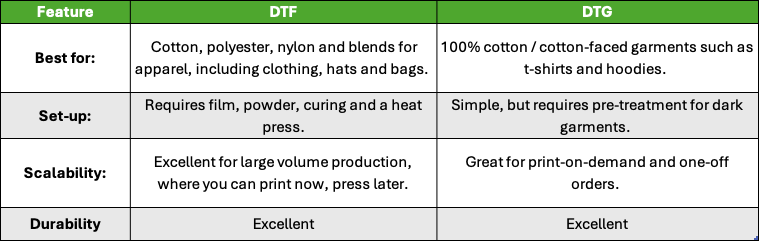
Both methods can produce high-quality results, but they suit different fabrics and workflows. This comparison table highlights the key differences at a glance, from the materials each works best on to what the process looks like day to day, so you can see which option fits your products and order volume:

Direct to Film T-Shirt Print

Direct to Garment T-Shirt Print
Equipment Set-Up and Running Costs
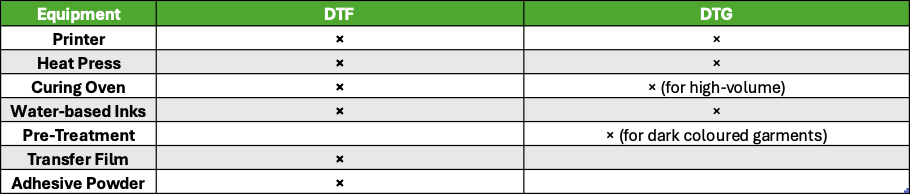
For both DTF and DTG printing methods, you’ll need to invest in your set-up, including hardware such as a printer and heat press and consumables such as inks.
The main cost difference comes from the consumables and workflow: DTF costs include film and powder (and curing), but it usually avoids pretreatment. While DTG has fewer consumables beyond ink, pretreatment (and the time to apply/cure it) is a key running cost, especially for dark garments.
DTF Pros and Cons
DTF is popular because it’s flexible and works across a wide range of fabrics, which makes it a strong choice for businesses that want variety. We’ve broken down the main advantages and trade-offs to help you decide whether DTF fits your workflow, product range, and the finish you want to achieve.
DTF Pros
Wide range of compatible fabrics
Your garments and fabric can be polyester, cotton, nylon, and blends, allowing you to offer your customers a variety of products.
Transfer film peel options
At Xpres, we offer a range of DTF film, including hot peel, cold peel and instant peel. Available in both sheets and rolls, you have the option of peeling your transfer straight away, whilst still hot or leave it to cool, whichever is easier for your workflow.
Very durable
DTF transfers have great washability and durability without fading or cracking. Quick tip – return your garment to the heat press for a second press to increase durability.
Print your transfers in advance
If you’d like more flexibility in your workflow, you can print and cure your transfers in advance, ready to press at a later time.
DTF Cons
Print Feel
Compared to DTG transfers, DTF prints can feel slightly heavier and less breathable. However, after a few washes, they will become softer.
More steps in the process
As you need to print onto a film first and cure the adhesive, this generally takes longer than DTG printing. However, for larger orders and volumes, you can invest in a large DTF printer, which can handle printing multiple designs on your roll of film.
You can also invest in an Adkins roll-to-roll DTF curing unit, designed and tested to integrate with various industry-leading DTF printers whilst delivering demanding volume without compromising output quality. Featuring automatic operating mode, fast curing times and low power consumption for reduced energy costs.
DTG Pros and Cons
DTG is often the go-to option for cotton garments and a softer, more breathable print feel. Like any print method, it has strengths and limitations depending on what you’re printing and how you operate. Here’s a clear overview of the main pros and cons so you can judge whether DTG is the right match for your business.
DTG Pros
High quality and detail
DTG produces excellent colour and can deliver great results for even the most intricate designs.
Soft Touch
As the ink absorbs into the fabric, this results in a print soft to the touch compared to DTF transfers.
Less waste
As the design is printed directly onto the garment, there is no need for plastic films, making this print method an eco-friendlier option.
Perfect for smaller orders
DTG is a great print method for a quick turnaround and cost-effective one-off or small batch orders.
DTG Cons
Limitations on fabric
For DTG printing, the fabric must be 100% cotton or cotton-faced garments for a successful print.
Design placement
As the garment is placed flat and secure on a platen, you might find that you’re limited to product types and where you can place the design on your garment.
One piece at a time
Although ideal for on-demand or small orders, a standard DTG printer will limit you to printing one garment at a time, not ideal for large volume orders. However, if your budget allows, you can invest in a more production-suited printer. To give you an idea, the Epson SC-F3000 DTG Printer can print 60 full platen dark T-Shirt prints per hour.
So, which should you choose: DTF or DTG?
If your product range includes a mix of fabrics — especially polyester, blends, or anything beyond cotton — DTF is usually the more flexible choice. Because the design is applied via a transfer, it works across a wider range of materials and is a great fit if you want to offer lots of garment types (and accessories) without constantly changing your setup.
DTG tends to shine when you’re focused mainly on cotton or cotton-faced garments, and you care most about a soft, breathable finish. Because the ink prints directly into the fibres, DTG is often a better option for larger prints where comfort matters — and it’s especially convenient for one-offs and small batches, provided pretreatment is part of your process for darker garments.
If you’re building a brand that sells both cotton staples and a wider mix of products, a hybrid approach can make sense over time: DTG for soft-feel cotton garments, and DTF when you need versatility or want to batch transfers and press them as orders come in.