
Your basket is empty
Print Direct. Print to Transfer. Your Call. Meet the Mimaki TX330-1800
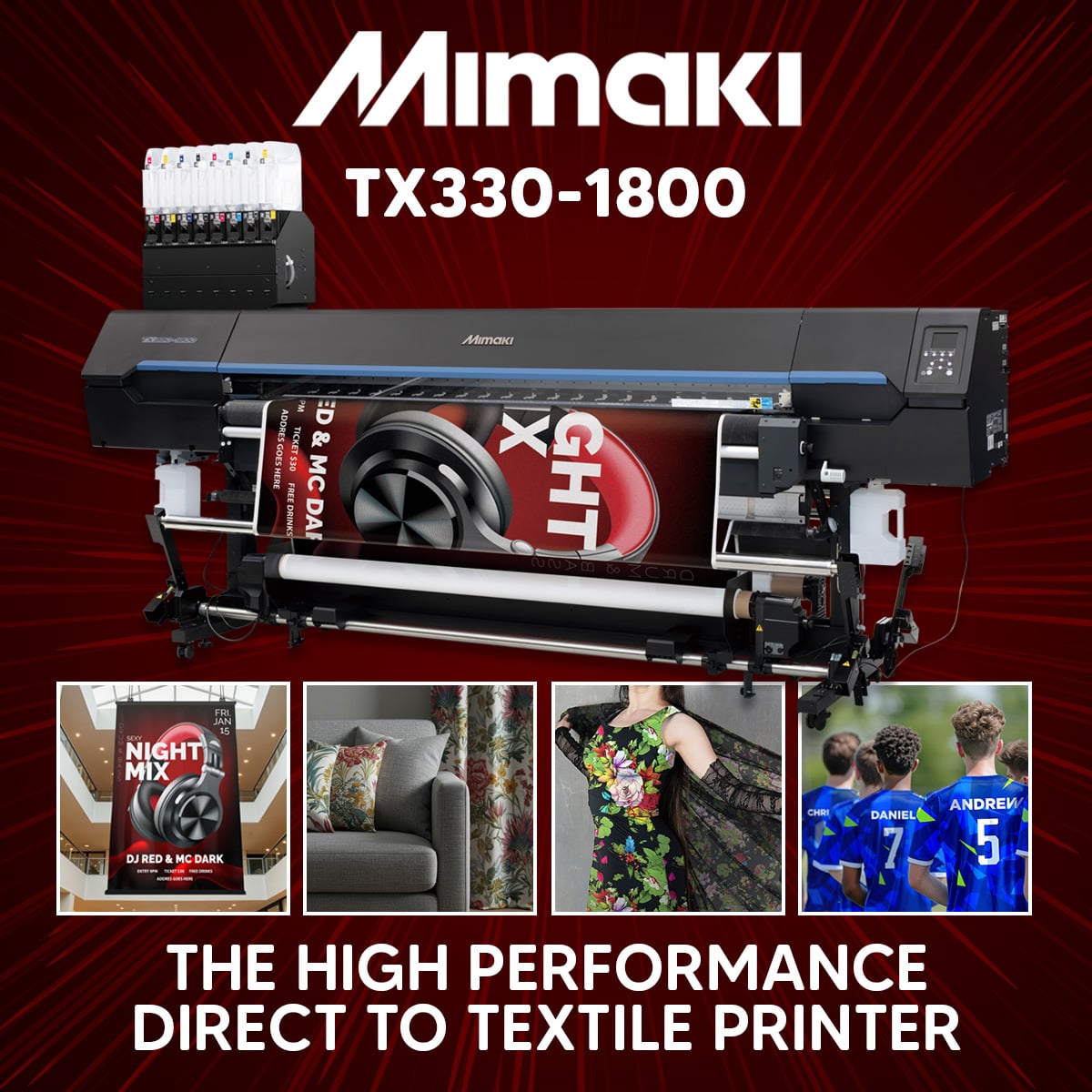
Natural fibres or synthetic. Direct-to-fabric or transfer paper. Pick one, buy the machine, and build your business around its limits.
The Mimaki TX330-1800 doesn't ask you to choose.
It's a 1.8-metre hybrid textile printer built to switch between production methods on the same machine, job by job, which means the fibre and the finish are decided by your client, not by which printer happens to be free on the shop floor.
Here's what that means for the work you can take on.
Two Ways to Print, One Machine to Do It
At the centre of the TX330-1800 is a system. Depending on the job, you can print:
Direct-to-fabric: ink goes straight onto the textile, ideal for soft signage, interiors and apparel where you want colour locked into the material itself.
Transfer paper: the design is printed onto paper first, then heat-applied to the fabric, giving you more control over which materials you use downstream and how the finish behaves.
Natural Fibres and Synthetics, Side by Side
The hybrid element goes further than the printing method. The TX330-1800 can run two ink families at once.
- TP410 textile pigment ink for natural fibres: cotton, linen, and blends. Ideal for curtains, apparel and general textile decoration.
- Sb420 sublimation ink for direct-to-polyester printing, built for vibrant, durable colour on synthetic fabrics. Ideal for fabric signage, soft signage and banners.
- Sb411 sublimation ink for transfer paper for polyester fabrics. Ideal for fashion, sportswear, personalised merchandise and interior décor.
Why a Hybrid Platform Changes the Equation
The most obvious benefit is space: one machine doing what would normally need two. But the more interesting shift is in production planning.
Cotton curtains and polyester banners have traditionally been handled by different equipment, often in different parts of the workshop, sometimes with different lead times. A hybrid platform brings both under one roof, so the question becomes less about whether a job fits the equipment and more about when it fits into the schedule.
It's a small operational change on paper, but it opens a wider range of work without a wider footprint.
Frequently Asked Questions
Can the TX330-1800 print onto cotton?
Yes. When configured with Mimaki TP410 textile pigment inks, the TX330-1800 can be used to print compatible cotton, linen and other natural or blended textiles.
Material testing is recommended because results can vary according to fabric construction, preparation and finishing requirements.
Can it also print polyester?
Yes. Dye-sublimation configurations allow the TX330-1800 to print suitable polyester applications either directly to compatible fabric or through a transfer-paper workflow.
Can pigment and sublimation inks be installed together?
Yes. A hybrid CMYK pigment and CMYK dye-sublimation configuration is available, allowing the printer to support both natural-fibre and polyester applications.
The two ink types remain within dedicated channels and are selected according to the material being printed.
Does pigment printing require washing?
The TP410 workflow has been developed as a near-waterless textile process and can remove the washing stage associated with many conventional textile ink technologies.
The exact process will depend on the chosen fabric and its intended end use.
Do I need a calendar fixation machine?
A calendar is normally required when producing dye-sublimation work through transfer paper. Direct sublimation fabrics also require an appropriate heat-fixation process.
Pigment workflows require suitable heat fixation, which may be carried out using compatible calendar or heat-press equipment depending on the product.
Xpres can recommend the correct fixation solution for your intended applications.
What is the difference between the TX330-1800 and TX330-1800B?
The TX330-1800 is the hybrid platen model designed to print onto both fabric and transfer paper.
The TX330-1800B incorporates an adhesive belt transport system and is designed for stable direct printing onto stretchy, thick or more difficult-to-transport fabrics.
Our team can help determine which model is best suited to your materials and production requirements.
Can I test my own fabric?
Yes. We encourage customers to provide representative artwork and materials wherever possible.
Testing your intended textiles is one of the best ways to evaluate image quality, colour, handling, fixation and overall workflow suitability.
How much does the TX330-1800 cost?
The final investment will depend on the chosen ink configuration, software, installation, training, fixation equipment and initial consumables.
Contact Xpres for a tailored quotation based on the complete solution your business requires.